
MUSE STEM CELLS
Nature's Pluripotent Repair System
While regenerative medicine shows promise in the rapidly growing body of scientific data, it has yet to be proven to be effective and it is not FDA-approved. All procedures are entirely elective.
We are very careful to only work with patients that we think we have a chance of helping based on our experience. Namely, patients who are in overall good health who suffer from chronic pain caused by damaged or degenerated musculoskeletal tissues (such as joints, spine, or ligaments), that is not “too far gone”. While we have helped many people, there are people we have worked with that we have not helped at all. Our experience is that overall, we help more people than we don’t help, but there is nothing about regenerative medicine that is either a “miracle” or a “cure”.
Dezawa Muse Stem Cells – Frequently Asked Questions
IV Stem Cells
What they are: Living, fully intact, replicating cellular entities from umbilical cord
The Mechanism: MSCs are structural “builders.” While they do not permanently engraft or turn into new organs, they physically home to areas of acute injury or chronic inflammation. Once there, they stay alive in the tissues for months, acting as continuous, smart “bioreactors” that release tailored healing signals in response to the microenvironment.
Primary Benefit: Maximum potency for structural damage, deep joint repair, severe tissue degradation, and complex systemic conditions requiring a sustained, long-term cellular response.
IV Stem Cell Exosomes (Extracellular Vesicles / EVs)
What they are: Non-living, acellular, microscopic lipid “bubbles” (30–150 nanometers) naturally secreted by stem cells.
The Mechanism: Exosomes are pure “messengers.” They do not contain live cells, DNA, or the ability to replicate. Instead, they are packed with a concentrated payload of growth factors, cytokines, mRNA, and microRNA. They float through circulation, fuse with the patient’s existing cells, and instantly deliver “blueprints” instructing those native cells to downregulate inflammation and accelerate self-repair.
Primary Benefit: High safety profile and immediate cellular signaling. Because they are non-living, they carry zero risk of replication or tumor formation, have exceptionally low immunogenicity.
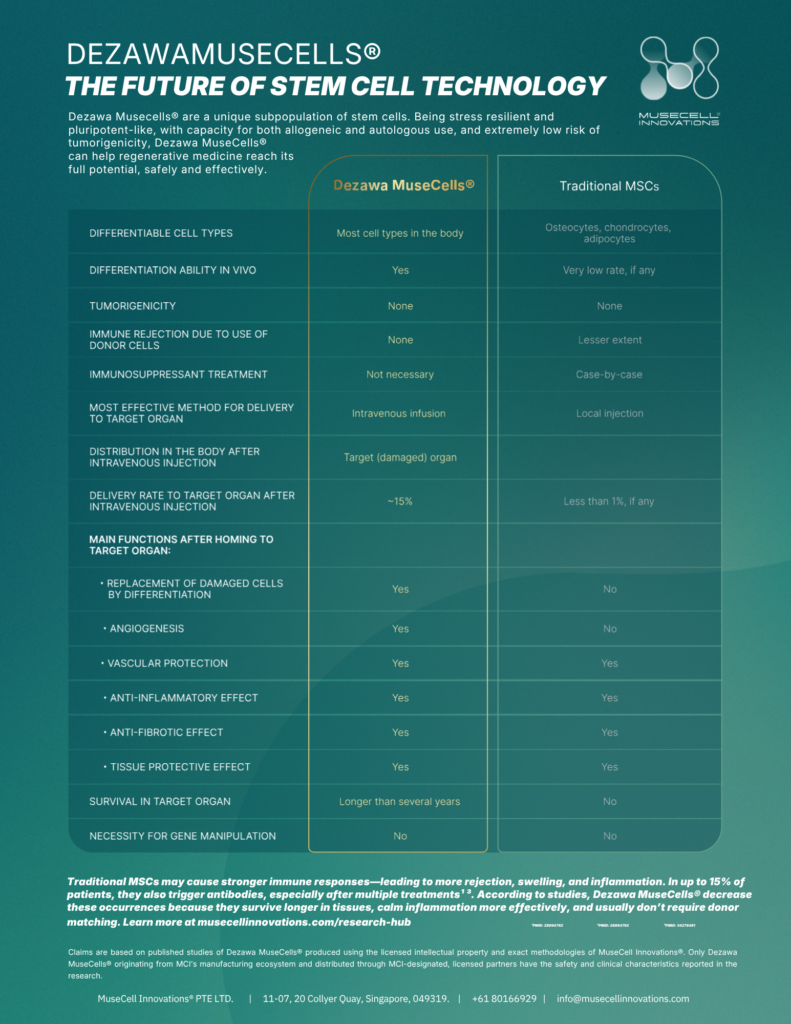
Dezawa MuseCells® are a distinct, naturally occurring subset of stem cells isolated from mesenchymal tissue. Three properties set them apart from conventional MSCs — and from other pluripotent platforms such as embryonic stem cells and iPSCs:
Pluripotency: They can differentiate into virtually any cell type in the body — not just mesenchymal lineages. And they do this spontaneously in vivo, in response to the local tissue environment, without genetic engineering or chemical induction.
Homing: They actively seek out tissue damage by following sphingosine-1-phosphate (S1P), a biochemical distress signal produced by injured cells. This makes intravenous delivery clinically viable in a way it is not for conventional MSCs.
Immune privilege: They express HLA-G and produce immunomodulatory factors that prevent rejection by the host immune system — enabling allogeneic (donor-to-patient) use without HLA matching or immunosuppressive therapy.
A fourth property — non-tumorigenicity — distinguishes them from other pluripotent platforms. Despite genuine pluripotency, Dezawa MuseCells® do not form teratomas. This is grounded in active molecular regulation: low telomerase activity, somatic-like cell cycle gene expression, and the Let-7/Lin28 microRNA axis that keeps oncogenic targets suppressed.
Phase II clinical trials in Japan — the most extensive Dezawa MuseCell® clinical dataset — used 15 million cells delivered intravenously as the primary dose. This figure reflects Japanese patient population size and body weight distributions.
For western patient populations, 20 million cells IV has become the standard starting dose used by MCI-authorized clinical partners, reflecting a proportional adjustment for larger average body size. This figure is not drawn from a Phase III dose-comparison trial — no such trial has been completed — and represents clinical consensus within the authorized practitioner network.
Published data and clinical experience support the following practical framework:
Standard IV dose: 20 million – 100 million cells
Local orthopedic injection dose: 5–20 million cells generally, based on provider discretion
IV is supported by the broadest published clinical trial evidence and works via the systemic homing mechanism. It is preferred for neurological, cardiac, immunological, and systemic indications, and any condition without a single accessible anatomical target.
Local injection is preferred when the primary treatment target is a specific, accessible orthopedic or musculoskeletal site. Clinical experience indicates stronger and more reliable local effect at the target site. Note that local injection also produces some systemic effect — consistent with the paracrine and immune properties of Dezawa MuseCells®.
Combined approach (IV + local injection) is reasonable for complex cases where both concentrated local effect and systemic distribution are clinically warranted. This has not been evaluated in a controlled trial.
No. Co-administration or closely timed use eliminates the S1P homing gradient and defeats the mechanism that makes Dezawa MuseCells® distinct.
Conventional MSCs suppress the S1P signal Dezawa MuseCells® use to find damaged tissue.
Use the products in separate, spaced treatment cycles — not combined.
Source through MCI-authorized supply partners only.
Require lot-level documentation showing ≥70% SSEA-3+ purity and 80–90%+ viability.
Verify the isolation antibody lot (BioLegend #330302 or Thermo Fisher MA1-020).
Any product that cannot provide SSEA-3 purity documentation should not be administered as Dezawa MuseCells® — it cannot be verified as such.
EXCELLENTTrustindex verifies that the original source of the review is Google. Friendly staff and a doctor that is easy to talk to. Effective treatment on my first visit. This may not be the case for everyone but in my experience, I have experienced positive life changes after just one visit. Highly recommended!Posted on GoogleTrustindex verifies that the original source of the review is Google. Posted on GoogleTrustindex verifies that the original source of the review is Google. Did not rush me . Gave his attention detail . Explained everything before doing anything . I would go back . I would recommend this DrPosted on GoogleTrustindex verifies that the original source of the review is Google. Great experience! I found Dr Islam very comforting and patient, and the staff is super nice. I’m feeling much better since starting bioidentical hormones. I’m on my third week and I already am feeling more energy, more myself, clearer thinking. Highly recommend. 😊Posted on GoogleTrustindex verifies that the original source of the review is Google. Outstanding service. Not a typical medical professional office. Runs like a top.Posted on GoogleTrustindex verifies that the original source of the review is Google. Dr is amazing...but front receptionist?! A total KEEPER and I just love her attitude and kind but no nonsense woman. I love real people. Hope she sticks around because that will make me want to stay, and I'll still send clients your way! More than 5 star for BOTHPosted on GoogleTrustindex verifies that the original source of the review is Google. I had an amazing experience at MedSpa with Dr. Islam! From the moment I walked in, the staff was welcoming, professional, and made me feel completely comfortable. Dr. Islam is incredibly knowledgeable, patient, and truly takes the time to explain everything in detail. I never felt rushed, and all of my questions were answered thoroughly. The results exceeded my expectations — natural, beautiful, and exactly what I wanted. You can tell Dr. Islam genuinely cares about his patients and their confidence. The spa itself is clean, modern, and relaxing. I highly recommend MedSpa with Dr. Islam to anyone looking for top-tier care and outstanding results. I will definitely be returning!Posted on GoogleTrustindex verifies that the original source of the review is Google. Dr Zamil Islam, is an extremely reliable and helpful doctor. Ever since my first visit, I have felt that I can be open with him and He has my best interest in mind. Another reason I continue to go to Dr Zamil Islam is because of Ceil she is beyond awesome! If I’ve ever had trouble with anything or had any questions She responds extremely efficiently and fast. Any time I speak with Ceil I know that my experience is going to be five stars. Thank you to Dr Zamil Islam and his great staff for helping me get my life back and keep it!Posted on GoogleTrustindex verifies that the original source of the review is Google. So far I’ve received excellent service. This is the nicest drs office I’ve ever been to period. Receptionist was so nice and professional. Dr was amazing. WORTHY OF 5 STARS!