
Umbilical Cord MSC Stem Cells · An Explainer
One cell source.
Two ways in.
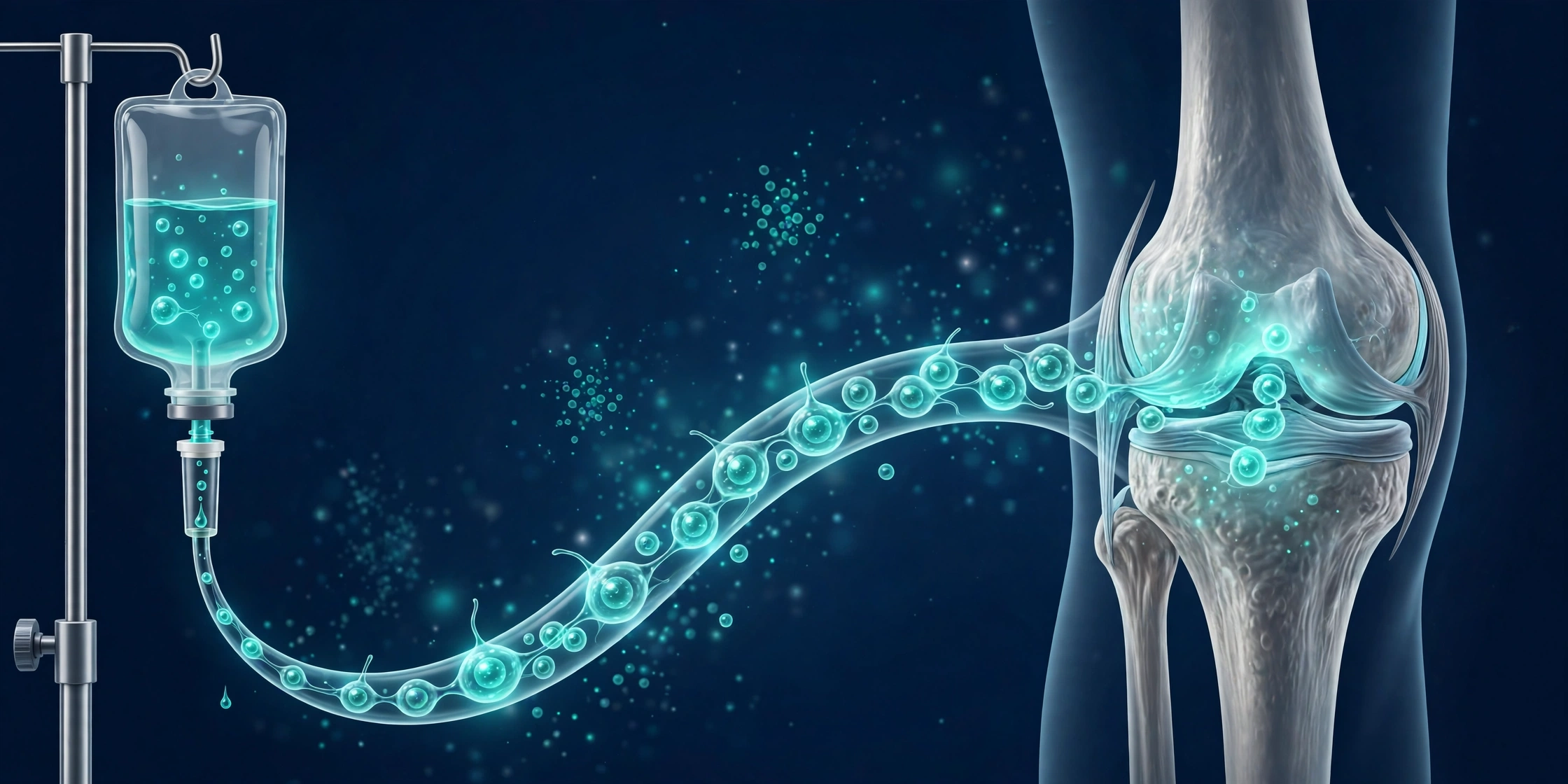
Mesenchymal stem cells (MSCs) from donated umbilical cord tissue can be placed directly into a damaged joint — or delivered to the whole body by IV infusion. This page combines our joints and IV pages into one: what these cells are, how each route works, how dosing is set, and short videos from our YouTube channel throughout.
- Every treatment performed directly by a licensed physician — Florida law allows only MDs and DOs to administer stem cell therapy
- Joint injection, IV infusion — or both in one plan, set at your consultation
- Honest about the evidence — regenerative medicine is promising but investigational, and not FDA-approved
Stem cell therapy is investigational and not FDA-approved. It is not a cure, and results vary. We only treat patients we believe we have a chance of helping.
The basics
What are umbilical cord MSCs?
MSCs are living, fully intact stem cells sourced from umbilical cord tissue — ethically donated after healthy C-section births and processed by regulated suppliers. They are the same cell type behind both of our stem cell services: injected into joints on the regenerative medicine side, and infused by IV on the systemic side.
Think of MSCs as structural “builders.” They do not permanently engraft or turn into new organs. Instead, they home to areas of acute injury or chronic inflammation and stay alive in the tissue for days to weeks, acting as smart “bioreactors” — continuously releasing healing signals tailored to the environment around them.
Umbilical cord MSCs are also low-immunogenic: they express few of the surface proteins that flag foreign cells, so no HLA matching is needed in practice. The field now describes them as immune-evasive rather than invisible to the immune system — immune responses, including donor-specific antibodies, have been documented in the literature.
They home to injury
MSCs physically travel to areas of acute injury or chronic inflammation — a worn knee, a damaged ligament, an inflamed system — rather than acting wherever they happen to land.
Living “bioreactors”
Once in place, the cells stay alive for days to weeks, continuously secreting tailored healing signals in response to the tissue around them — not a single one-time dose of medicine.
Low immunogenicity
Cord MSCs express few of the surface markers that flag foreign cells, so no HLA matching is needed in practice. Researchers describe them as immune-evasive, not invisible — immune responses have been documented, so low-risk is not no-risk.
They wake up your own cells
The signals delivered in the first weeks change how your own local tissue cells behave — downregulating chronic inflammation and restarting self-repair that continues after the donor cells are gone.
The source
Where umbilical cord MSCs come from
Our MSCs are isolated from Wharton’s jelly — the gelatinous connective tissue inside the umbilical cord that cushions and protects the cord’s blood vessels. The cord is donated with consent after a healthy birth, and donors and tissue are screened — medical history review and infectious-disease testing — before the cells are processed by regulated suppliers.
Because they come from newborn tissue, cord MSCs are younger than the MSCs in an adult’s bone marrow or fat: they divide more readily (more proliferative) and haven’t accumulated decades of wear. And because the cord would otherwise be discarded, there is no harvest procedure from your own body — no bone-marrow aspiration, no liposuction.
One clarification, because the older pages muddied it: Wharton’s jelly is the source tissue these MSCs come from — not a different cell type and not a separate therapy. Listing “stem cells” and “Wharton’s jelly” as two treatments, or as a combination of the two, describes the same material twice.
The Muse connection
Inside these same umbilical cord MSCs sits a rare subpopulation: Muse cells (multilineage-differentiating stress-enduring cells) — the SSEA-3+ fraction, roughly 1–5% of the MSC population. They are the pluripotent-like, stress-enduring cells covered on their own page: read the Muse stem cells explainer →
Two ways in
Joint injection, IV infusion — or both?
The cells are the same. What changes is where they’re delivered: concentrated into one damaged joint, circulated through the whole body, or both as part of a single plan. Your physician sets the route — and the dose — after evaluating you.
Placed exactly where it hurts
A targeted injection delivers MSCs directly into the damaged joint, spine area, or soft tissue — the highest concentration of cells at the site of degeneration, with the goal of supporting repair of cartilage, ligament, and tendon tissue.
- Knee, shoulder, and hip pain; arthritis and degenerative joint disease
- Meniscus, tendon, and ligament injuries; sports injuries
- Back and neck pain, pinched nerves, popping / grinding / clicking joints, instability
- Often chosen by patients hoping to delay or avoid surgery, when appropriate
What it feels like afterwards
Most patients resume normal activities within 24–72 hours, though restrictions vary by treatment. In the first days, some soreness is normal — it’s often part of the healing response.
- Temporary soreness, mild swelling, or stiffness
- A mild, temporary increase in discomfort for several days is common
- Can be combined with PRP, prolotherapy, or exosomes in a single protocol
Systemic, by gravity drip
An IV infusion circulates MSCs through the whole body. Because the cells home to injury and inflammation, a single drip can reach multiple problem areas at once — deep joint damage, widespread pain, and complex systemic conditions that no single injection could cover.
- Virtually zero downtime — return to normal activities right after the drip
- Some patients notice a mild, temporary “flu-like” feeling or fatigue for about 24 hours — a normal sign the immune system is responding
- Wellness & longevity: typically once every 6–12 months
- Chronic inflammatory support: a loading phase of 2–3 infusions, 2–3 months apart, then annual maintenance
What patients commonly report
We treat for orthopaedic, pain management, and wound care purposes under Florida law. Alongside that, patients commonly report other benefits from IV stem cells, such as:
- Less chronic inflammation and joint / muscle discomfort
- Support with autoimmune conditions and immune system regulation
- Less brain fog, cognitive and neurological wellness support
- Recovery after illness, and general wellness optimization
These are effects patients commonly report — not approved uses. Florida permits stem cell therapy only for orthopedics, pain management, and wound care, and it is not FDA-approved to treat, cure, or prevent disease. Individual results vary.
Local repair + systemic support
Many patients do best with both: an injection concentrates cells in the one joint that needs structural help, while an IV infusion addresses inflammation everywhere else. Combination protocols are standard practice in our clinic, not an exception.
- PRP + stem cells — growth factors plus advanced cellular signaling
- Stem cells + exosomes — regenerative cells plus the signaling that directs repair
- Stem cells + exosomes + PRP — a combination protocol pairing cells, signals, and growth factors
Add exosomes for a dual-phase effect
Co-infusing live stem cells and exosomes in the same session pairs a rapid action phase with a long-term engine: the exosomes deliver immediate signaling while the cells keep working for weeks.
- Enhanced cellular communication and anti-inflammatory support
- Improved stem cell activation and survival
- Think of stem cells as the “workers” and exosomes as the “instructions” that direct the repair
The honest caveat — in our own words
“We are very careful to only work with patients that we think we have a chance of helping… patients who are in overall good health who suffer from chronic pain caused by damaged or degenerated musculoskeletal tissues that is not ‘too far gone.’ While we have helped many people, there are people we have worked with that we have not helped at all. There is nothing about regenerative medicine that is either a ‘miracle’ or a ‘cure.’”
Florida law
Strict rules — and a physician does your treatment
Florida law is strict about patient safety. Only fully licensed medical doctors (MD) or osteopathic physicians (DO) may perform stem cell therapies — nurse practitioners, physician assistants, and medical assistants cannot independently prescribe or administer them. Every procedure in our clinic is overseen and performed directly by a licensed physician, and physicians are restricted to three clinical areas:
Orthopedics
Joint degeneration, cartilage wear, ligament tears, and related musculoskeletal damage.
Pain management
Chronic back pain, systemic joint pain, arthritis, and chronic pain from damaged tissue.
Wound care
Non-healing ulcers, severe tissue damage, and chronic skin wounds.
That limit is why effects like autoimmune support, less brain fog, or neurological wellness appear on this page only under “what patients commonly report” — they are patient reports, not Florida-approved uses of stem cell therapy.
Watch & learn
MSC stem cells, in short videos
Shorts from the Age Well Dr YouTube channel. They are introductions, not proof — the evidence behind regenerative medicine is still developing.
Stem Cell Results: 100% Pain Relief & Mobility
One patient’s reported result — individual results vary, and no outcome is guaranteed.
Watch on YouTube →A Patient’s First Month: 75% Pain Reduction
One patient’s reported result — individual results vary.
Watch on YouTube →Regenerative Therapies, Easily Explained
Watch on YouTube →100 Million Stem Cells + 200 Billion Exosomes
Watch on YouTube →More videos on the Age Well Dr YouTube channel
Side by side
MSCs vs. exosomes — workers and instructions
Both come up in almost every treatment plan, and they are not interchangeable. MSCs are living cells; exosomes are the messages those cells send.
| MSC Stem CellsUmbilical cord | Exosomes (EVs)Extracellular vesicles | |
|---|---|---|
| What they are | Living, fully intact, replicating cells from umbilical cord tissue | Non-living, microscopic lipid “bubbles” (30–150 nm) naturally secreted by stem cells — no cells, no DNA, no replication |
| How they work | Home to injury or inflammation and act as living “bioreactors,” releasing tailored healing signals for days to weeks | Pure messengers — they fuse with your existing cells and deliver growth factors, cytokines, and microRNA “blueprints” that instruct them to calm inflammation and self-repair |
| Primary benefit | Maximum potency for structural damage, deep joint repair, severe tissue degradation, and complex systemic conditions needing a sustained response | Immediate cellular signaling with a high safety profile and exceptionally low immunogenicity — no live cells, so they cannot replicate; the risk is considered very low, though never zero |
| How delivered | Targeted joint / tissue injection, IV infusion, or both | Co-infused by IV or added to an injection protocol in the same session |
Which joint therapy fits which problem?
- Prolotherapy→ joint instability
- PRP→ mild arthritis & tendon injuries
- Exosomes→ inflammation & recovery
- Stem cells→ advanced degeneration
These therapies are frequently combined — your physician matches the protocol to the joint, the imaging, and how far the degeneration has progressed. Wharton’s jelly doesn’t appear as its own rung: it is the cord tissue the stem cells are isolated from, not a separate therapy.
Dosing
How many cells — and who decides?
The ideal dose depends on body weight, age, health goals, severity of symptoms, and the treatment protocol. As a rule of thumb, comprehensive outcomes are dosed at 1–2 million MSCs per kilogram of body weight. Our MSC dose options:
Targeted starting dose
A focused dose for a single joint or a smaller, well-defined problem area.
Single-area / wellness
Within the 25–50M range commonly used for general wellness goals.
Wellness & longevity
The lower end of the 50–100M range used for longevity optimization.
Comprehensive IV
For systemic goals — the dose featured in our “100 Million Stem Cells” video above.
Preparing for treatment
Prep matters — the merged checklist
Proper preparation improves your body’s healing response. The joint and IV protocols differ slightly on timing; your provider confirms your exact windows. Key rules from both:
- Stop NSAIDs. Ibuprofen (Advil, Motrin), naproxen (Aleve), celecoxib (Celebrex), meloxicam, diclofenac, and high-dose aspirin — 14 days before an IV infusion; 7 days before and after a joint injection. Acetaminophen (Tylenol) is the safe alternative.
- Clear corticosteroids well ahead. Oral steroids (e.g. prednisone) and recent steroid injections suppress stem cell activity — allow 2–4 weeks before joint treatment and 4–6 weeks before an IV infusion; your provider sets the washout.
- Hydration loading. Drink 64–80 oz of water daily for the week before your appointment — it expands blood volume, smooths IV delivery, and supports cell membrane integrity.
- Vitamin D3. Supplement toward a serum level of 40–60 ng/ml, which supports stem cell self-renewal and healthy differentiation.
- No alcohol or nicotine for 72 hours before treatment — and avoid smoking whenever possible around your protocol.
- Eat for repair. A healthy, protein-rich diet in the run-up supports the healing response the therapy depends on.
Candidacy
Who MSC therapy may — and may not — be for
We are careful to only work with patients we think we have a chance of helping. Candidacy is decided by our physicians at consultation — but this is the honest shape of it.
More likely to be a candidate
- In overall good health, with chronic pain from damaged or degenerated joints, spine, or ligaments
- Knee, shoulder, or hip pain; osteoarthritis; meniscus, tendon, or ligament injuries
- Sports injuries, sprains, instability, or frequent swelling that hasn’t responded to conservative care
- Hoping to delay or avoid surgery when that’s realistically appropriate
- Seeking systemic support for chronic inflammation within Florida’s approved areas
When we’ll likely say no
- Damage that is “too far gone” — some joints are honestly beyond what regenerative therapy can help
- Anyone expecting a miracle or a cure — we’ll say so plainly before you spend anything
- Goals outside Florida’s approved areas (orthopedics, pain management, wound care)
- Patients unable to complete the prep protocol — NSAID and steroid washouts exist because they change outcomes
How it works
What treatment involves
Evaluation
Our physicians review your history and imaging and tell you honestly whether you’re a candidate — and for which route. If the damage is too far gone, they’ll say so.
Route and dose are set
Joint injection, IV infusion, or both — plus your cell dose and any add-ons like exosomes or PRP — are decided with you, along with your prep timeline.
Treatment day
A targeted injection or a gravity-drip IV infusion, performed directly by a licensed physician. Then it’s back to normal life — virtually no downtime for IV, 24–72 hours for most joint work.
Questions
Umbilical cord MSCs — FAQ
Merged from the Florida IV Stem Cells FAQ and the Regenerative Medicine FAQ.
What’s the difference between a joint injection and an IV infusion?
The cells are the same umbilical cord MSCs. An injection concentrates them in one damaged joint or tissue for structural repair; an IV infusion circulates them systemically, and because MSCs home to injury and inflammation, they can reach multiple problem areas at once. Many plans use both.
How many stem cells do I need?
It depends on body weight, age, health goals, severity of symptoms, and the protocol. The general guide is 1–2 million MSCs per kilogram of body weight for comprehensive outcomes. Our standard dose options are 10M, 25M, 50M, and 100M cells, and your physician sets the final dose at consultation.
How long do the cells stay active — and how long do benefits last?
IV-infused MSCs remain alive in tissue for about 2–4 weeks. Their signaling “reprograms” your own cells during that window, so patients routinely continue improving for 3–6 months — sometimes up to a year — after a single treatment, long after the donor cells are gone.
How often can I do an IV stem cell infusion?
Because live cells keep signaling for weeks to months, frequent administration isn’t needed. For wellness and longevity, once every 6–12 months is standard. For chronic inflammatory support, an initial loading phase of 2–3 infusions spaced 2–3 months apart may be recommended, followed by annual maintenance.
Is there downtime or a risk of rejection?
Downtime is virtually zero after an IV infusion; most joint patients resume normal activities within 24–72 hours. As for rejection: cord MSCs have low immunogenicity and no HLA matching is needed in practice — researchers describe them as immune-evasive rather than invisible to the immune system, and immune responses, including donor-specific antibodies, have been documented. Some IV patients feel mildly “flu-like” or fatigued for about 24 hours, a normal sign the immune system is responding to the new signaling.
Can these therapies be combined with PRP or exosomes?
Absolutely — many patients receive combination protocols: PRP + stem cells, stem cells + exosomes, or stem cells + exosomes + PRP. (Wharton’s jelly isn’t a separate add-on — it’s the cord tissue the stem cells themselves are isolated from.) Co-infusing cells and exosomes gives a “dual-phase” effect: immediate signaling from the exosomes plus weeks of work from the living cells.
Can stem cells replace surgery?
Not always. Many patients seek regenerative therapy before considering surgery, and some experience significant improvement — but no treatment can guarantee avoiding surgery, and damage that is too far gone won’t respond. That’s exactly what the consultation is for.
Who is legally allowed to administer stem cell therapy in Florida?
Only fully licensed medical doctors (MD) or osteopathic physicians (DO). Nurse practitioners, physician assistants, and medical assistants cannot independently prescribe or administer these treatments, and physicians are restricted to orthopedics, pain management, and wound care. Every procedure at Age Well Dr is performed directly by a licensed physician.
Are these treatments FDA-approved?
No. Regenerative medicine shows promise in a rapidly growing body of scientific data, but it has not been proven effective and is not FDA-approved. All procedures are entirely elective, and results vary from patient to patient.